If you want more elbow room but still need practical access to Greater Portland, Durham deserves a closer look. For many first-time buyers, the challenge is finding a home that feels peaceful and rural without pushing daily errands, work, or travel too far out of reach. Durham can offer that balance, and understanding its market, lot sizes, and rural-property details can help you decide if it fits your next move. Let’s dive in.
Why Durham appeals to first-time buyers
Durham is a small Androscoggin County town with about 4,262 residents spread across 38.3 square miles. That works out to roughly 111 people per square mile, which helps explain why the town feels open and lightly developed. The town also describes itself as a quiet, off-the-beaten-path place between the Maine Turnpike and I-295.
If you are hoping for land, privacy, and a quieter setting, Durham checks those boxes better than many closer-in commuter areas. At the same time, it is still positioned near major southern Maine travel corridors. That combination is a big reason buyers look here when they want rural space without feeling cut off.
Durham’s location near Greater Portland
Durham is best understood as a drive-to-everything town rather than a walkable suburb. Route estimates place Durham about 15 minutes from Freeport, 20 minutes from Brunswick, and around 30 minutes from Portland, depending on your exact address, weather, and season. For buyers who work, shop, or travel throughout the region, that access can be a real advantage.
You also have nearby transit options outside town. Amtrak Downeaster stations operate in both Freeport and Brunswick, and station information notes daily METRO Breez express bus service between Portland, Yarmouth, Freeport, and Brunswick. Durham itself is still rural in character, but these nearby connections can add flexibility.
What “rural space” really means in Durham
In Durham, rural space is not just a feeling. It is built into the town’s land-use rules. In the Rural Residential & Agricultural District, the minimum lot size is 90,000 square feet, or about 2.07 acres, with 300 feet of minimum road frontage and a 40,000-square-foot minimum buildable envelope.
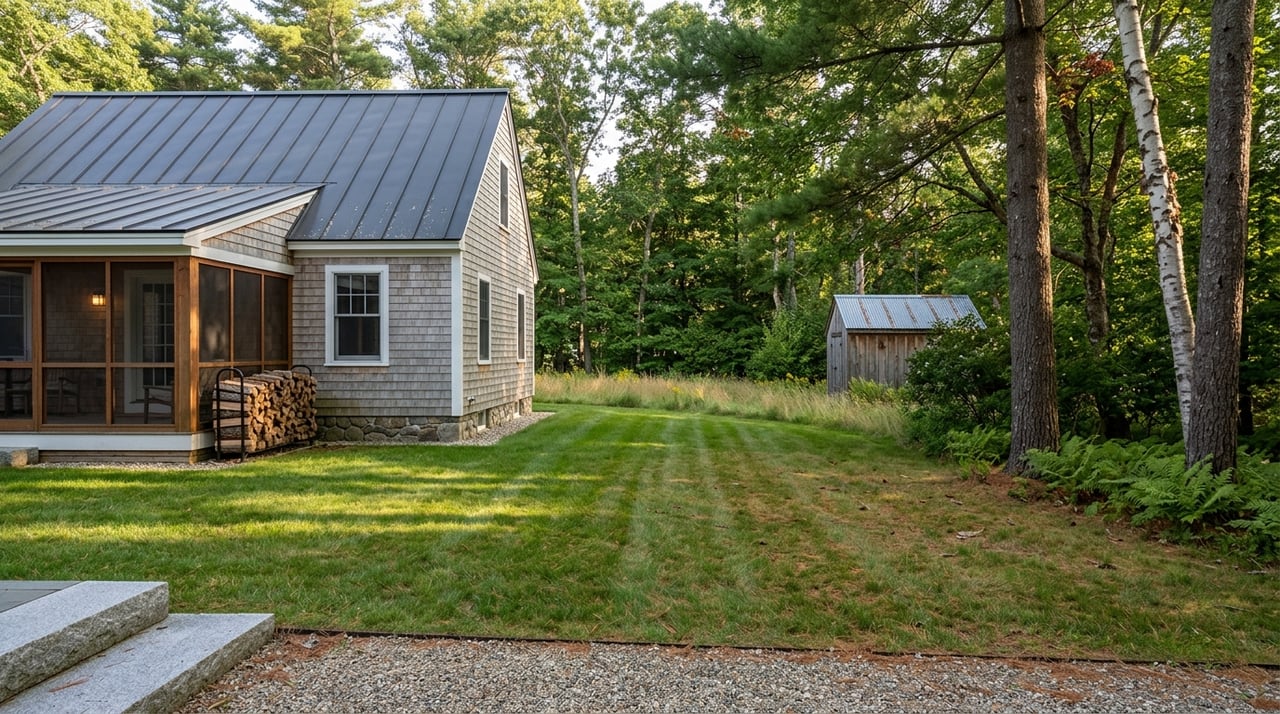
That matters because it shapes what you should expect when you start browsing homes or land. In many cases, you are not comparing small suburban lots. You are looking at larger parcels that may offer privacy, yard space, woods, or room for outbuildings, depending on the property and local rules.
What first-time buyers may find on the market
Durham’s housing data can look inconsistent at first glance because the town is small and inventory is limited. Redfin shows only 6 homes for sale, 5 homes sold, a recent sale price of $675,000, 12 days on market, and a 3.6% premium over list price. Zillow’s home-value index for Durham is lower at $450,323 as of April 30, 2026.
The gap between those figures is a good reminder that Durham is not a one-price market. Home values can swing widely based on acreage, condition, age, and whether the property is an older starter home, a larger rural house, or a new build. As a buyer, you will want to compare properties carefully instead of assuming one headline number tells the whole story.
Current listings show that range clearly. Recent active inventory included a $294,500 four-bedroom, one-bath home, a $997,000 new-construction four-bedroom, two-bath home, and land listings around $150,000 to $174,000 for parcels between 2.4 and 2.65 acres. That spread suggests Durham can work for some first-time buyers, but it also attracts buyers looking for more space and higher-end rural homes.
Financing options worth checking early
For first-time buyers in Maine, MaineHousing’s First Home Loan is one of the most important programs to explore. MaineHousing defines a first-time buyer as someone who has not had an ownership interest in a principal residence within the past three years. The program requires acceptable credit history with a minimum 640 credit score, and MaineHousing notes that buyers should generally plan for monthly housing costs around 30% to 33% of income.
The program offers low fixed-rate mortgages with little or no down payment options. MaineHousing’s Advantage option can also help with down payment and closing costs. For eligible buyers, the First Generation program can provide a $10,000 grant.
USDA financing is also especially relevant in Durham because of the town’s rural setting. USDA’s Single-Family Housing Guaranteed Loan Program allows eligible borrowers to buy in qualifying rural areas with 100% financing, as long as the property and borrower meet program rules. If keeping cash-to-close low is a top priority, this is one of the first things to verify.
Rural property due diligence matters here
A Durham home search is not just about bedrooms, baths, and acreage. Rural properties often come with private systems and practical questions that deserve close attention before you commit. In Durham, that is a central part of buying wisely.
The town states that there are no public water utilities in Durham. That means buyers should expect private wells rather than town water in many cases. The town’s code-enforcement information also says all work related to septic systems, except routine pumping or filter cleaning, requires a permit.
For you as a buyer, that points to a few key due-diligence items:
- Well inspection and water quality testing
- Septic system inspection and age review
- Private-road access and maintenance questions
- A clear understanding of lot layout and usable land
These are not reasons to avoid Durham. They are simply part of buying in a rural town where the property itself often plays a bigger role in your long-term ownership experience.
Is Durham a good fit for your lifestyle?
Durham tends to make the most sense if your priorities include land, privacy, and a slower setting, but you still want reasonable access to Freeport, Brunswick, or Portland. It may be a strong match if you are priced out of closer-in areas and are willing to trade walkability for space. It can also be appealing if you like the idea of a home that feels more tucked away.
On the other hand, Durham may feel less convenient if you want dense services, public utilities, or a neighborhood built around shorter lots and closer homes. The town has the municipal basics buyers usually look for, including a town office, public works, fire and rescue, solid-waste management, code enforcement, and planning functions. Still, the overall footprint is small-town and rural, not urban or suburban in the usual sense.
How to shop smart in Durham
When you search in Durham as a first-time buyer, it helps to focus on both affordability and property complexity. A lower list price on paper may still come with well, septic, or site considerations that affect your budget and comfort level. Looking at the full ownership picture can help you avoid surprises.
A smart search usually includes these steps:
- Confirm your financing path early, including MaineHousing or USDA eligibility.
- Set a budget that accounts for monthly housing costs, closing costs, and inspection needs.
- Review each property’s lot size, layout, and access, not just the house itself.
- Plan for well and septic due diligence as part of the buying process.
- Compare commute patterns to the places you actually need to reach each week.
That approach can make Durham feel much more manageable, especially if rural living is new to you.
Why local guidance helps in a town like Durham
In a small market, broad averages only tell part of the story. One home may be a modest entry point, while another reflects new construction, more acreage, or a very different condition profile. That is why local, property-level guidance matters more in Durham than in a larger town with more uniform housing stock.
If you are trying to balance budget, location, and land, it helps to work with someone who can put each listing in context. That includes helping you compare commute tradeoffs, lot-size expectations, and the practical realities of rural ownership. For first-time buyers, that kind of clarity can make the search feel much less overwhelming.
If you are exploring Durham and want help sorting through acreage, commute tradeoffs, and first-time buyer options, Paul Clark can help you build a smart, locally informed search.
FAQs
Is Durham, Maine really a rural town for homebuyers?
- Yes. Durham has a low population density, the town describes itself as quiet and off the beaten path, and its land-use rules are built around large minimum lots.
How much land can first-time buyers expect in Durham?
- Many properties in Durham are on larger parcels. The Rural Residential & Agricultural District has a minimum lot size of about 2.07 acres, and recent land listings included parcels from 2.4 to 2.65 acres.
Can first-time buyers use MaineHousing in Durham, Maine?
- Often, yes. MaineHousing’s First Home Loan program is available to eligible first-time buyers who meet credit, income, and other program requirements.
Can USDA financing work for Durham home purchases?
- In many cases, yes. Durham’s rural setting makes USDA financing especially relevant, but both the property and the buyer must meet USDA eligibility rules.
What should buyers inspect on rural homes in Durham?
- Buyers should pay close attention to private wells, water quality, septic systems, septic age, and access or road-maintenance issues, since Durham does not have public water utilities and rural systems are common.
Is Durham a reasonable commute to Portland, Freeport, or Brunswick?
- Route estimates place Durham about 15 minutes from Freeport, 20 minutes from Brunswick, and around 30 minutes from Portland, though actual drive times vary by address, traffic, weather, and season.